Mobile Phone Cameras in Teaching and Learning

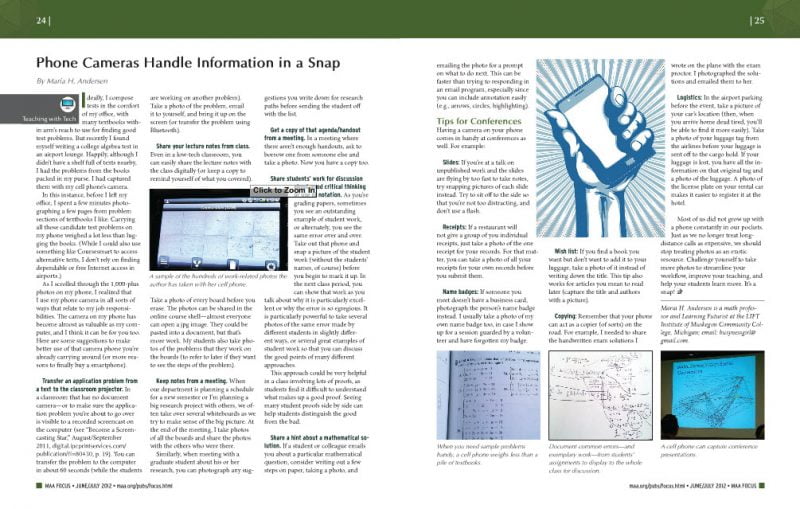
My latest “Teaching with Tech” column for MAA Focus just published this week.

Phone Cameras Handle Information in a Snap!

Teaching with Tech: Phone Cameras Handle Information in a Snap!


Here are the general topic areas:

  • Carrying a library of “good problems” with you for topics you are teaching.
  • Transfer an application problem to the computer/projector in your classroom.
  • Share your lecture notes from class (from a blackboard, whiteboard, or document camera).
  • Keep notes from a meeting.
  • Make a copy of a handout or meeting agenda.
  • Share student work for discussion about good methods or errors in thinking.
  • Answer emailed questions easily.
  • Tips for Conferences

Phone Cameras Handle Information in a Snap!

Archive of Teaching with Tech Columns


Possibly Related Posts:


Share

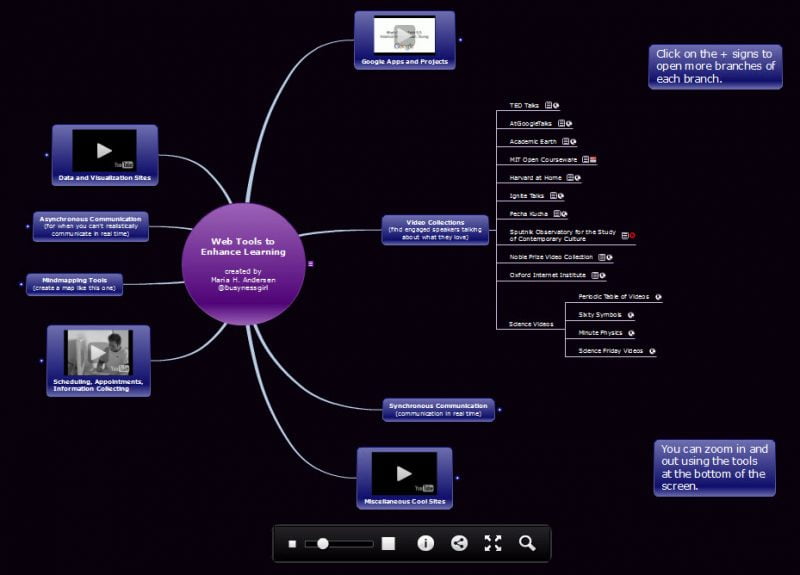
Web Tools to Enhance Learning

Here’s a new mindmap containing my recently organized collection of great sites and tools for learning and teaching.  The collections are:

  • Google Sites and Apps
  • Video Collections
  • Synchronous Communication Tools
  • Asynchronous Communication Tools
  • Mindmapping Tools
  • Data Visualization
  • Scheduling, Appointments, and Information Collecting

Mindmap: Web Tools to Enhance Learning

To see more digital mindmaps, go to Resources: Mindmaps.

Possibly Related Posts:


Share

What if you don’t have enough whiteboards?

Just a quick post to share this video from Betty Love (University of Nebraska – Omaha). Betty attended our MCC Math & Technology Workshop in 2011 and really wanted to try paired boardwork with her students during class. The problem? Not enough whiteboards/chalkboards. The solution? Well, just watch!

If you’ve got pictures or video you’d like to share of your Math ELITE Classroom redesign, or how you’ve incorporated the principles into your teaching, please do!

Possibly Related Posts:


Share

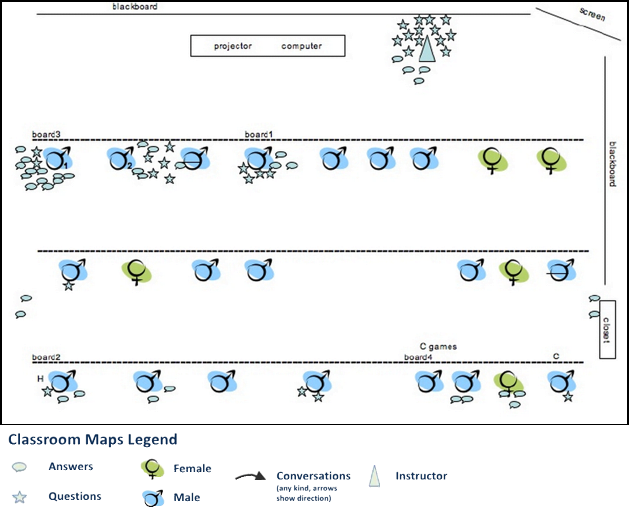
What does the classroom say?

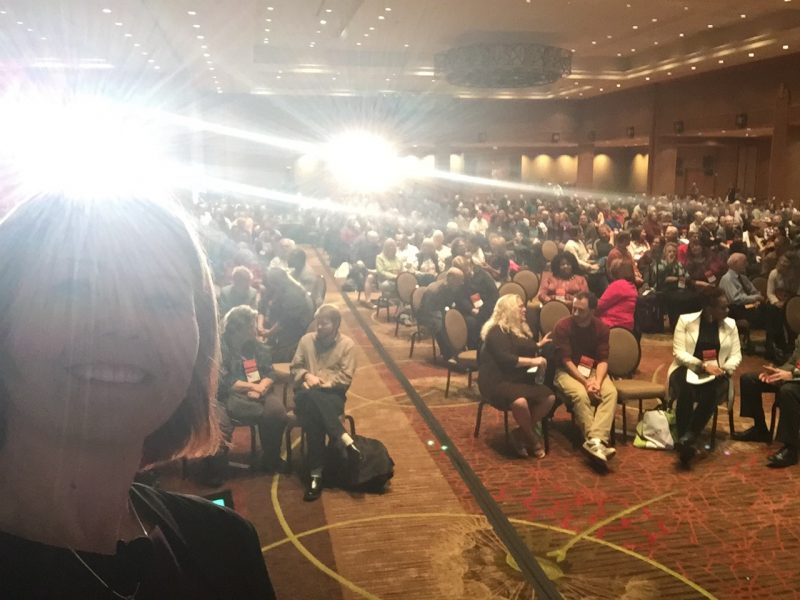
Yesterday I had a short talk in the ITLC Themed Session called “Change the Classroom, Change the Learning” about the necessity of math classroom redesign.


Without changing the classrooms, it is unlikely that we will see much change in the instructors or students.

Here is the video from the talk, called “What does the Classroom Say?” and the slides from the presentation.

Possibly Related Posts:


Share

Delusional Hindsight and Academe

In a previous post this week, I discussed optimism bias and student success in online classes. Optimism bias causes us to paint a rosy picture of the future (even when it’s not likely).  But what about when we whitewash the past?  I’d like to propose that we call this delusional hindsight.  Some of us are able to learn from our past mistakes.  Others not so much.

Let me outline my reasoning.  I’ve been reading Generation Me, by Jean Twenge.   In this book she suggests that “Generation Me” is particularly good at pushing blame to others because it is the only way to deflect it from hitting their self esteem.  If you admit to doing something wrong, then you wouldn’t feel very good about yourself, and Generation Me has been taught that the most important thing in the world is to feel good about themselves (to have high self esteem).

Suppose a student signs up for classes late ever semester.  Every semester he doesn’t get the classes he needs.  Every time the registration date looms, he ignores it, registering late again. It seems to us (the instructors) that this student is unable to remember that his procrastination usually ends badly.  However, I no longer think this is an inability to remember, but an inability to causally link Action A (late registration) with Action B (unable to get desired classes).  How could the student possibly reason away the self-blame for registering late?

  • The reason he didn’t get the desired classes because the college doesn’t offer enough sections or seats.
  • He couldn’t register any earlier because he hadn’t made the important decision to go back to school yet, and that was a decision requiring careful consideration, not to be rushed.
  • He didn’t want to use financial aid, and was trying to save up enough to pay for the classes himself before registering.
  • He didn’t want to trouble a counselor during the “busy season” so he considerately waited to register.

When we were discussing this last weekend, my husband suggested that we call this process of whitewashing the past “delusional hindsight.”  This should not be confused with hindsight bias (the tendency to view events as more predictable than they really are).

delusional hindsight: to impose a misleading belief upon the understanding of a situation after it has happened

Just like with optimism bias, I can think of dozens of examples of delusional hindsight in academe.  Here are a few (hopefully you can tell which ones apply to students and which ones to professors):

  • Signing up for 8am classes, even though you’ve never been able to get up that early.
  • Waiting till the last minute to write a paper, even though past experience should tell you it doesn’t work well for you.
  • Telling yourself you don’t need an alarm clock despite sleeping through class regularly.
  • Telling yourself this will be the semester that you pass fill-in-the-blank-class, even though you haven’t changed anything since the last time.
  • Swearing to yourself you won’t take any paper-grading home this semester, even though you’ve sworn this at least five times before.

I think that delusional hindsight and optimism bias go hand-in-hand.  Without a retelling of the past, it would be impossible for a student taking Beginning Algebra for the 4th time to even give it an attempt.  Can you imagine placing the blame for failure (three times) squarely on your own shoulders and then taking it again?  How depressing.  Much better for the psyche to place the blame on the textbook, instructor, time of day, difficulty of exams, sick relatives, change in work schedule, etc.  With this whitewashing of the past, it is possible to be optimistic about the future.

I think it’s helpful to see these cases of delusional hindsight for what they are.  Once you begin to recognize the faulty thinking, it becomes a little easier to cope with student excuses (and our own delusions) that just don’t seem to make sense.  We are whitewashing the past for a reason, and that reason is us.  The question is, once we know this … what do we do to help us and our students to move past the cycle of delusional hindsight and optimism bias?

Possibly Related Posts:


Share